Skip to content

Past Exhibitions


Solo show by Mona Aghababaee

In her organic forms, Mona Aghababaee creates both positive and negative spaces, the created works are manifestation of spaces of her mind. She integrates materials and evokes abstract forms to challenge boundaries of perception. The essence of her sculptures are the continuum of her mind. Simple organic shapes evoke figurative links and natural materials are forced to change shape, while the forms are abstract, they refer to living forms.

In the words of artist:
Objects, out of ourselves, seemingly quiescence, quite and passive; lacking subjectivity but ever present in my mind. I stare at these objects, to the point that I take their shape, I am swallowed, in a continuous spiral; perplexed and confounded to point of ambiguity, a hybrid reality.
Parasites have changed the ant, it’s neither an ant nor a parasite. The eggs of the parasite tasted and looked like food and the ant swallowed it and it became the bait. Where is the ant? What of the parasite? This transmutation, is it the reality?
….Between me and The Other, there is a consistent dialogue which erodes both of us. It molds us and is the source of our decadence…
Solo show by Nasser Bakhshi
In collaboration with Nader & Nader LLC.

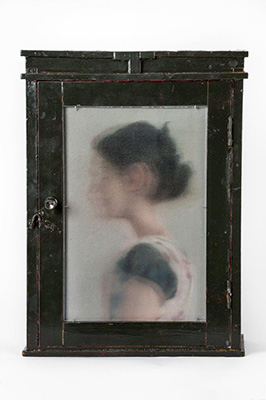
Nasser Bakhshi is a self taught artist and lives far from the hustle and bustle of the Capital, in the wonderful land of Azerbaijan. He places his memories and bits of his soul and heart as well as our collective memories inside old boxes that he finds in forgotten corners of the city of Tabriz.
The assemblages have an indefinite quality. The boxes act as repositories, as if at a later time the artist will revisit these visual documentaries of his life and time, and will add his new memories and perceptions. The mundane objects next to the extraordinarily painted pieces create time capsules that are decidedly poetic. The discarded boxes and bits and pieces that were once beautiful and useful, are tenderly rearranged to whisper the story of a life. The intimate quality of these works tempt the viewer to open the boxes and drop pieces of their own life in to the mix.
The extraordinary quality of drawing and paintings create instant classics. Besides images painted from photographs as simulations of reality, the drawings are “simulation of something which never really existed”. The combination of the two genres adds to the excitement and marvel of the boxes.
While the large scale paintings stand on their own strength and beauty, it becomes increasingly difficult to separate them from the boxes. The large paintings are “details” of the paintings within the boxes; taken out of their place and accentuated, a reverse action of seeing with magnifying glass. They seem to come out of the boxes to deliver their own monologues. The boxes are accumulation of images and elements that artist lives with and they narrate the dreams and wishes, as well as failures and uncertainties of their creator; who is one of many, one of us, many of us.


Solo show by Nogol Mazloumi

It has taken Nogol Mazloumi, exactly One thousand three hundred sixty Hours and twenty-one minutes to complete the startlingly powerful drawings of this exhibition. It is an archaic attitude, one that is retention of an age old practice of Iranian artists and their interest in pen and ink drawing which is well documented to Il-Khanid period (1256-1353 AD). For centuries Iranian artists, in their solitude, have created marvelous imagery, a separate world where they have found the redeeming answer to brutality chaos and frustration that seems always to have been a part of daily life.
Nogol Mazloumi is preoccupied with notion of death and non existence. For the catalogue she writes: The notion of before and after life which is incomprehensible to us, is void. Death is a boundless void, and in its intervals life exists. Death is not performed and is not a position, it’s devoid of any act. But it contains all acts because it engulfs life. In reality It is life that happens. So in this way death is both life and it is not.
In these breath taking drawings, artist creates life and beauty out of her fixation with death. Through her lines music flows and the harmony which the eye enjoys as it passes to and fro over the compositions is soothing. Here is Phoenix rising from ashes, phoenix who is believed to possess the knowledge of all times and the netherworld. From ashes she arises to create life and wonderment. She plunges in to flames to be purified and to rise again. It is this self renewing quality in Iranian art that has been the merit and source of its survival through dark times with artists who have boldly faced their own demons and have risen above expectations, each time stronger, each time mightier.


Solo show by Arash Sedaghatkish

For Arash Sedaghatkish it is all about learning, and practice of patience, energy and time, in order to complete and to excel. This is accomplishment arrived at by great effort and determination; the strengthening of the body and the mind, the learning and the perfection of one’s skills and excellence achieved through long practice.
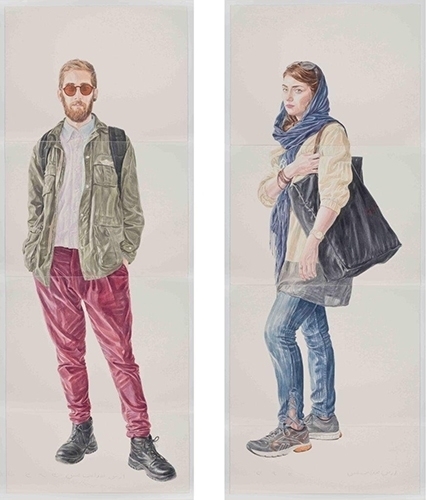
Through his watercolors, artist explores the boundaries of the medium, the conviction of scale in watercolor and the necessity or accordingly lack of the background. The paintings are fluid and translucent, as is water color. In these series spots of color and water come together, in a slow motion and patient manner, to create large scale paintings that their accuracy and size are contradictory to the well established genre of water color painting. The control of artist on the medium and his clarity about his subject is evident and the next act is to have the animated subjects of the paintings at the gallery to complete the installation.


Solo show by Baktash Sarang

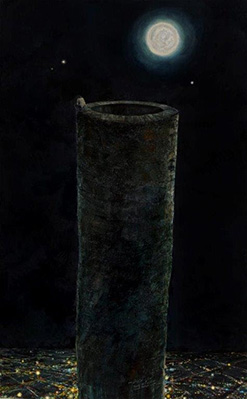
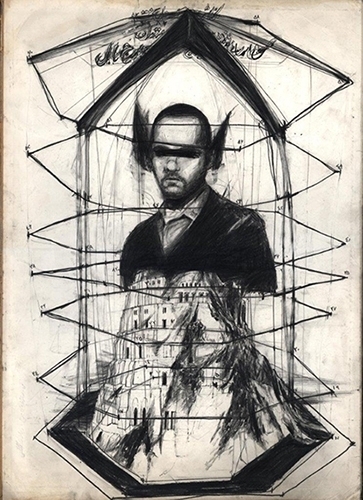
The Tower of Babel is a story told in the Book of Genesis, of a people who spoke one language and they said, “Come, let us build ourselves a city, and a tower whose top is in the heavens; let us make a name for ourselves, lest we be scattered abroad over the face of the whole earth.”. But the Lord came down to see the city and the tower which the sons of men had built. And the Lord said, “Indeed the people are one and they all have one language, now nothing that they propose to do will be withheld from them. Come, let us go down and confuse their language, that they may not understand one another’s speech.” So the Lord scattered them over the face of all the earth, and they ceased to build the city.*
The Tower of Babel is the story of a failed utopian project, and probably that is the common trait in all utopian projects, ideas and projects that attempt to build utopia, but find meaning in close encounter with failure and the more idealistic they are the possibility of failure is larger. If the tower of Babel ever existed, the location would have been the historical city of Babel in Mesopotamia, the region called Middle East today, where the contemporary history of the region, is not unlike the story of Tower of Babel. The region where even its current given name is a challenge by itself and its contemporary history of wars and struggles (often inflicted from outside), with waves of revolutions, civil wars, collapses and changes of Regime –all happening in short spans of time- is the embodiment of idealism and failure.
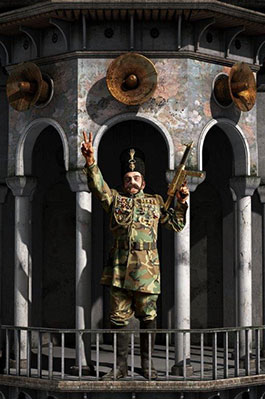
A region that seems to be fenced in and resembles a forbidden zone where ruins of many towers, in state of decay and decline, can be found. Towers that are the epitome of the idealism of their builders and quite often reminders of despotic regimes that have attempted to build their Ideological towers whilst their people are forced to live with constant fear and terror, the kind of fear that Mikhail Bakhtin called Cosmic Terror.

Solo show by Dadbeh Basir

The photographs of Dadbeh Bassir have a certain vivacity, and that is perhaps why you Encounter them. The act of ‘taking’ a photograph is not mundane to him; every detail from inception to method is thorough, and the final product gives viewers as much as it takes from them. The viewer responds to the images, and it appears that it is this reaction that the artist anticipates above all.

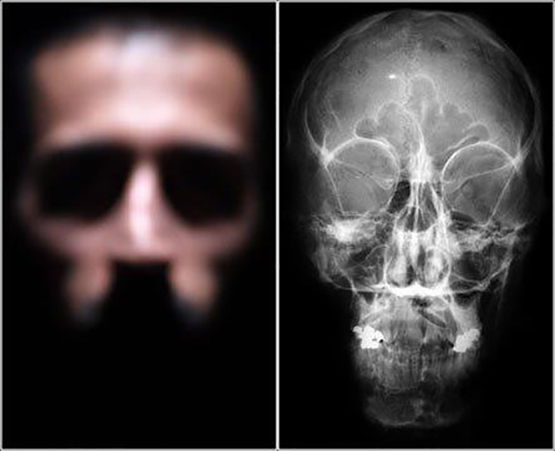
He weaves his personal emotions into his paced-out narratives. In his self-portraits, he faces his dilemmas; He dissects scans and x-ray films of his own body and demystifies them, and the sinister unknown becomes an object of utter beauty. In a similar approach, by juxtaposing the bland cityscape and the infinite sky – through the careful placing of the mirror, the artist creates a dreamlike world where uncertainties and fears are omitted.
The Feared Unknown is now embraced and made into the Familiar; thereby, the world is altered, tangible, and likable.
Dadbeh Bassir’s involvement with image-making is measured and profound; every single piece feels pre-determined and unwavering. Every Shot is treated as The Last Shot. His body of work appears to be a collective response to the world, whether as a series of works or single frames.

For this exhibition, he has chosen works that are visually different from each other, the cohesion is to be found through careful study of the concept of each image, and the clue will be to take the title of the exhibition as the precursor and to fit in the single pieces into the crossword.
And that is perhaps why he is simply the best-kept secret in the vibrant photography scene of Iran. This exhibition will be a rare occasion to study this brilliant image maker and his mannerism.


Solo show by Ramin Rahimi

Everything in the Universe is moving, every given spot in our planet is moving and the planet rotates around the sun and the sun rotates around Milky Way Galaxy. The molecules and atoms which make up everything are vibrating, colliding, and moving at a speed that thus far has been unreachable by inventions of human kind.
Life is a perpetual movement. The art of all arts is to capture a three dimensional contextual moment. Art is nuptials of thought and motion. Whether the motion is movement of the body of a painter while using a brush, or the three dimensional image makers‘ movement of a digital pen. Or as George Innes has observed: The true end of art is not to imitate a fixed material condition, but to represent a living emotion.

Ramin Rahimi has managed to produce motion in his art and thereby has moved away from the Fixed Image where time is suspended. He invites us to see The Sun, the perpetual movement and it’s dynamics. A call to observe the vibration of pulse of life, and simultaneously to the eloquence of silence.
In a series of digital moving-portraits and with two video pieces, he successfully transfers the constant motion of life and the rhythms of nature; the rise and the setting of sun and the return to the inception point.


Solo show by Mandana Moghaddam

Under: nedanför, nedom, lägre än, inunder,täckt av, dold av, underverk, mirakel, fenomen, kraftgärning, märklig händelse, tecken trollslag,trolleri, tur, lyckträff, stordåd, prestation, under över alla under märkligt, underligt nog,oväntade,märklig händelse, mirakel, tur…Landet:stat, nation, rike, fosterland, territorium,jordstycke, jordplätt, täppa, jord, odlingslott, fastland, fast mark, plantering, rabatt, trädgårdsland, grönsaksland,
Below, below the, less than underneath, covered, hidden by, marvel, miracle, phenomenon, strange occurrence, character, magic, lucky fluke, deed, wonder of wonders strange, oddly enough , unexpected, miracle, luck…State, nation, kingdom, homeland, territory, piece of ground, piece of land, plot, land, fast land, firm soil ,allotment, planting, garden beds, vegetable garden

Artist talk: Sunday, 23rd November, 5 pm


Solo show by Mahmoud Mahroumi

The itching of body or “what the sculpture Demands from me”
It is seventeen years since as a laborer in a factory producing concrete electrical posts, I was in charge of assembling the metal casts. My main responsibility was to make sure that the casts were properly fastened before the cement was poured. If the bolts and nuts were not properly secured, the mould would flatten or because of pressure the cement would reject the cast.
Since then concerns such as: Inhibition and discipline of materials, tightening liquidity, inner sanctums, destruction and entropy, order and modern splinting, totalitarian thoughts in application of materials, have carved a specific path for me.
Whenever I have tried to escape this hitch or play a different game, I have been caught in a different manner. As if this “entanglement” is a pleasant thing.It’s seventeen years since this itching has turned my body to a gigantic mould, and I am constantly scratching myself.
Mahmoud Mahroumi – 2012


Solo show by Kamran Diba

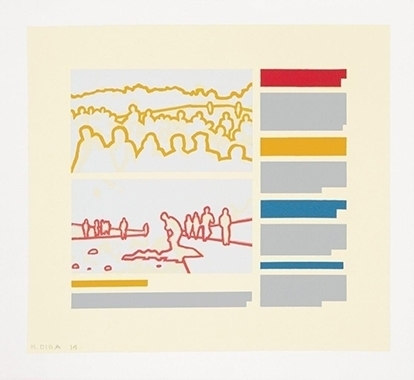
Kamran Diba’s cosmopolitan view of the world is reflected in recent paintings. There is no focus on local or national issues in choosing the themes and narratives. He assumes the news to be the “heart beat of human activity on earth, without it the indication of life on the earth seizes to exist” . He does not, however, focus on issues like various modes and approaches in news broadcasting, objectivity or lack of it, taking stance, and mind control through media. Regardless of the content of “global news”, he does not consider his work as being political. He believes that unlike artistic creation, politics is an issue of transient nature. The newspaper format is seemingly used as a ready-made template for painting. Even an echo of Formalist developments in Western art history might be traced in the general tendency of these series of paintings towards abstraction. In the present show the drawings have become much more simple and geometric. The previous realistic renderings have been replaced by abbreviated, geometric drawings. It is more difficult to guess about the themes and narratives, and the references have become more laconic. Major news events such as war, economy, politics and so on, are coded in pure, primary colours on the white canvas ground.
Kamran Diba’s ties to Iranian Art history are multiple and intense and his profound effect on the formative years of Iranian modern art movement is undeniable. In the same way, the course of his artistic practice strongly reflects the ups and downs of Iranian contemporary Art.
Helia Darabi – September 2014

Exhibition catalog: http://www.aarangallery.com/publications/catalog-news-clippings/


Solo show by Leila Ghandchi

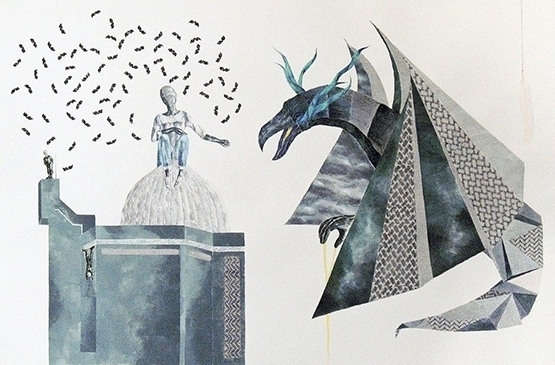
Leila Ghandchi is not a feminist activist, however she is ready to saddle up her Unicorn and confront the dominating powers in quest for a sliver of joy. This is the buzz of a young confident generation of female Iranian artists who will not easily surrender their individuality and are not ready to be the sacrificial lamb.
The Majestic domes and fabulous landscapes are the playgrounds for the artist, where real populace are in daily combat with the restraining antiquated attitudes . The application of mixed media in this series are meant to represent her subconscious; sterile gauze covers wounds, mesh is restrictive, feathers are wings to fly with.

The function of three dimensional Origami forms that are flattened, carry the paintings to a three dimensional level, and the intricacy of these tangled shapes are indicative of the complexity of the characters of the society. The usage of neon lights, hidden in the back of some of the paintings, are probably reaffirmation of the ancient Persian belief in the power of light and hope.

The fluidity of the landscapes, the delicate lines and almost transparent figures, are all reflective of the delicate balance that the artist successfully creates. A world of her own, where the amphibious creatures are neither heroes nor victims. And perhaps this is another declaration of independence of the valiant Iranian females.


Solo show by Hamid Hemayatian

The Ambiguous and Distorted Historical Identity

In his paintings Hamid Hemayatian addresses the distorted linkage of historical narrative, a history that has deep roots in his own appreciation of it. Displaying historical motives seems to be an instrument to tell the story of artist’s personal feelings that he is not able to openly express. History referred to in his paintings with signs and motives, seems to be an excuse to create contradiction to reveal these subdued feelings. A feeling that within the context of distorted historical narrative, creates more ambiguity in artist’s motivation.
The paintings in their candor are vague and it appear as if the artist does not want to demystify this explicitly. The contradictions, predominantly, are a consequent of reactions to personal life of artist; or perhaps it’s a larger glance at social and political currents and that artist by inserting formal historical narrative, conceals his chief intention.


Solo show by Nasim Davari

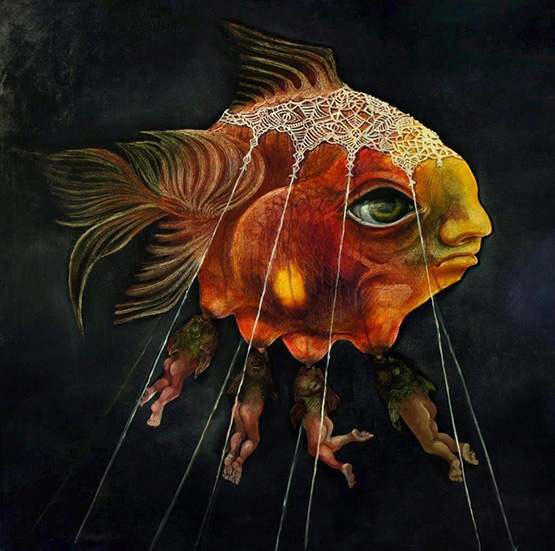
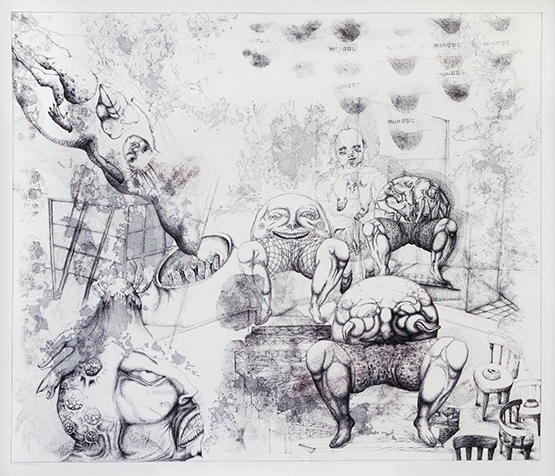
Nasim Davari defies our aesthetic conventions. She continues her interest in hybrid forms, and elicits a sense of wonder in her mysterious creations. For the viewer it is the ultimate unknown, for artist it is her Personal Encyclopedia, her cosmology, her Ajayeb Nameh. A meta mythical fantasia in an unconscious world, an extraordinary plenitude of disorienting detail. All these vivid images and impossible juxtapositions and reveries are part of her fantasia. A world hard to adjust to but once first shock waves are absorbed and the viewer finds a new interpretation, then the bizarreness no longer appears all that unusual.
Following in footsteps of Abu Yahaya Zakariya Qazwini, the 13thcentury Persian intelligentsia; Geographer, Astronomer and extraordinary writer, who created the immensely popular “Marvels of Creatures and the Strange Things Existing”, our young artist pictures the perplexing creatures that in her case reside in her own subconscious.
Each painting is an independent work but they are all linked with threads and colors and composition, allowing the viewer to glide in this incredible world. It’s best not to try and explain but to float in the magic that she creates. Stepping away from these paintings the world is once again factual and mundane.

Abu Yahya Zakariya’ ibn Muhammad al-Qazwini (أبو یحیی زکریاء بن محمد القزویني) or Zakariya Qazvini (Persian: زکریا قزوینی) ‎(1203–1283) creator of titled “Marvels of Creatures and the Strange Things Existing” (عجائب المخلوقات وغرائب الموجودات).
Qazwini also wrote a futuristic proto-science fiction titled; Awaj bin Anfaq (أوج بن أنفاق), about a man who travelled to Earth from a distant planet. – Wikipedia


Solo show by Aliyar Rasti

Questioning notion of time, Aliyar Rasti will present six video art works that have been in making for almost two years. These works are a play between staged and documentary image-making; by documenting real time events in Long Takes and deluding the essence of time, he attempts to create loops. Continuous moving images that are trapped in time.

Born in 1988 and an ardent student of renowned film maker, Kamran Shirdel, using his considerable technical skills by applying long takes and invisible cuts , he successfully creates an illusion of continuity, perhaps his own personal reality.

For this exhibition he writes:

Occurrences do not begin but are a continuous eternity

In passage of time we arrive to a point of occurrence
and experience it.
Based on our experiences we categorize occurrences
and create borders.

Borders break down the polarity of Being
and credence repetition.


Solo exhibition by Mehdi Eshlaghi

This exhibition is the result of my wonderings in the place and time that I am born in. It is thirty odd years that every corner of this city is rooted in my memories but I still lose my way. The city that I have grown up in, that we have grown up together, without guiding signs and no one to show the way. A geographical point, between Caspian Sea and the Capital, A passageway that has absorbed millions of people, where the inhabitants remain migrants and everyone belongs to another place.
“Karaj, Long Shot” is the title of a series that despite first impressions is not a Non-place, each image in fact is a reflection of an exact place and time, where day has turned to night and night to day. And ultimately it’s not a painterly visualization of a lived experience in a city, but it is a review of the reality in a city that seems to be centuries old.

The series is a test between choices and reflections of ugliness and beauty, right and wrong, as well as a choice between things that one can not chose among. A visualization of the battle between day and night; the illusion of rightfulness of one and decay of the other one. The Image of a terra nullius, a place between hallucination and reality, that one has probably witnessed at time of birth. And it appears that till the end we may never fully trust the light nor fear the darkness as much as we ought to.

The result is eight paintings, half day and half night, that continue in to each other. Perhaps a not so definite answer to the eternal question: that as far as time immemorial, light is born from darkness and dawn from dusk. And it’s only color that will give them both meaning and life.

Mehdi Eshlaghi. Spring 2014


Solo exhibition by Siamak Filizadeh

I will rule you in a different manner, if I stay alive…
Attributed to Nāṣer-al-Dīn Shah at the hour of his death

A vast city that slowly breaths in the dark depths of the earth. An ancient city, as old as the history of Human despotism. A high wall embraces the city. A wall that according to orders of The King, is decorated with patterns of love.
The King that every fifty years, at an exact date and hour is assassinated. The funeral ceremony that is held is more elaborate every time with the crumbling Tomb built even larger.
The next day The King rises from his tomb and goes to the palace, and his dominion is repeated with no alteration.
It is said that The King has made a pact with the angel of death, and there are others that believe that the citizens of the city are recalling his name in their hearts and ask God to return him to them.
The History of this city has been written once and for eternity, it has a circular motion , where the beginning is the end.
The Name of This City is “Under Ground”.


Solo exhibition by Allahyar Najafi

The story that you narrate is similar to installing colored glass on the windows of your house. Whatever is out there, whatever is moving, you get to see the colored glass and the darker or lighter shadows behind them. The story that you tell is not about the depth of life, it’s a recounting of passage of life. Your story is a patchwork of sub-stories, petty stories that not a lot of people care to tell.

The two and half dimensional imagery that are sold at the corner of the streets tell their own tale as well. One winks, the other ones jumps from the wolf to tiger and tiger to eagle, another shows the depth of forest. The final image is similar to what you get to see behind your colored windows. You see “what” you want to see. And there is no particular reason for it. And it’s not even necessary to explain it. It’s your story, the wink of the other, or the story of another one. A patchwork which is just like life. Each part exists for a reason. Very much like a fly that flutters to leave, but gets to change the air around us and it doesn’t even know it.


Solo show by Elika Hedayat

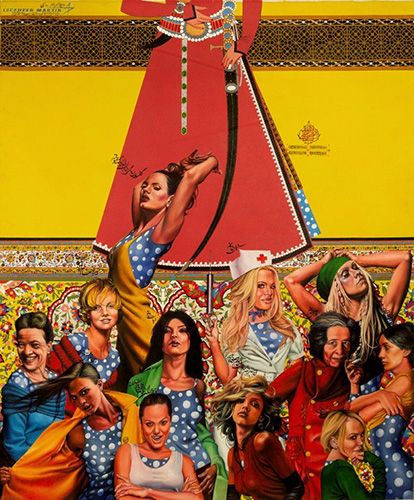
Elika Hedayat addresses aspects of exploitation, indifference, injustice and degradation of public life. She pictures the subaltern citizens and the essential duplicity necessary for their existence, duplicity that is evident in relationship of deceiver and deceived. The “chain” of bodies in her work makes it impossible to recognize who is or is not a victim.
The characters are determined to be noticed, they insist to be seen. The self satisfied populace with their absolute perseverance to Exist. Her work is decidedly disturbing and at the same time they are portrayals of parts of society, ranging from ridiculous to parody. Incomplete or mutilated bodies, bodies without locations. They stand without a beginning or end and evidently with no direction.
Elika Hedayat, with precision and unapologetically invites us to reflect on the hypocrisy and chaos that governs the streets of Tehran. These are snap shots of parts of our society, reminding us of the vulgarity, exhibitionism and under lying tensions of Petit powers.
It is an art that can be understood in the disorder of the reality that it is portraying. But it also shows us that as long as our progressive artists are willing to push the limits, by the mere fact of their existence they are the denial of the darkness. And there lies the strength of Iranian art and promise of a far better future.


Solo show by Arita Shahrzad

Ode To A Garden Carpet – By an unknown Sufi Poet (Circa 1500)
Here in this carpet lives an ever-lovely spring; Un-scorched by summer’s ardent flame, Safe too from autumn’s boisterous gales, Mid winter’s cruel ice and snow,’Tis gaily blooming still. Eyes hot-seared by desert glare find healing in its velvet shade. Splashing foundations and rippling pools, In cool retreats sore-wearied limbs restore, And tired hearts awake with joy once more. The way was cruel.
Baffled by monotony and mocked by phantoms delirious, Beset by stalking Death in guises manifold; The dreaded jinns, the beasts ferocious, The flaming heat and the exploding storms; Form all these perils here at last set free; In the Garden all find security.
Here the long-laboring Earth at last gives birth. From apparent death, a new and lovely world is born; Below the desert’s dusty floor, the jacinth imprisoned lies. The stony wilderness so bleak and bare, In ageless patience broods, aware of a life within, the promise of fertility and abundance. Ever longing for deliverance. The world at last reveals its destiny.
Can we not then capture and restore The loveliness that gave us hope, Still brightly mirrored on memory’s gliding waters Or snared in the poets’ invisible net, So wide, so fragile, Yet captor and conqueror of realities elusive?
Wrought in gold and azure, bright as carved metal. Dream-like foliage in sparking tones is caught, Or else, in sumptuous shades of glossy lacquer, Quiet but intense; in muffled browns and honey pure, Jasper cool and mellow cinnabar, That fairy land comes real again.
In sudden collisions find sweet embrace; In rhythms enchanting, with stately pace, Or rollicking speed; emerging, retreating, Reversing, in peaceful finality . Their conflicts reconcile, All in confederation blending Like a chorus in part-song gladly singing, In contrapuntal play rejoicing, Floating soft or wildly free; Yet anchored in eternity.


Solo show by Behdad Lahooti

“Zokhrof” is gold, it is the ideal beauty, adornment and elegance of things and yet, it connotes beautiful lies, much like adorned ravings or seductive talks. Thus, none of these pieces are adorned with gemstones and the series is called “Prong” a claw-shaped type of binding used for mounting gemstones to the jewelry item. All is thus ready for prong setting, yet there are no gems.
All sculptures of the series are devoid of both function and decoration and beautifully crafted prongs remain empty. Paradoxically things have lost their function, as well as their essence of beauty and have turned to a different thing and yet, through the process of refining have gained a seductive beauty of another order.
Excerpted from the catalogue of the exhibition, foreword by Barbad Golshiri


Solo show by Sasan Abri

In the hidden corners of this turbulent and ever changing city that claws and tears it’s own historic flesh asunder to devour it in the name of progress, leaving nothing but a monstrous creature, a few trees still stand tall. Trees, often pines, that hide something in their shadows as if to protect it. They are guardians of the past; guardians of spaces in the territory of a lost time when there was still art in laying brick upon another brick. Yellow bricks dormant in silent uninhabited walls. The pines are the main emblem of these houses. They herald from afar that they are surrounding and watching over a building that has long gone to sleep. Barely breathing, yet still beautiful, with a living identity. You can still hear their sound, the sound of pale yellow. The sound of crows and sparrows, the sound of lightening and relentless rain, the sound of the incessant honking of generations of cars and bulldozers and the battle cry of electrical saws and the thunder of iron and concrete that draws ever closer.
Sasan Abri


Solo show by Rene Saheb

The rebirth of our language in its new form after Arab invasion is accredited to grand poets such as Rudaki, Daghighi, Ferdowsi, Unsuri and many others. They used poetry to revive not only the language but the values, history and customs of Ancient Persia. However it was the successful oral transfer of Persian history, by performing groups or individuals, called “Gusans” that laid the foundation and carried the burden particularly in the two centuries after the invasion.
A great part of Iranian heritage is carried through orally and the ability and tendency to versify every day expressions is a two millennia practice. One such practice was reciting poetry during the longest night of the year, the Eve of Yalda*, with family and friends sitting around a stool like frame of wood, covered with blankets, under which a fire was placed for heating. These stools are called “Korsi”. The tradition of “Korsi Sher” was recitation of classical poetry which could easily become satirical and humorous once the night dragged on. The poetry reading of this tradition is still alive but Korsi’s are removed from households.

This exhibition coinciding with the longest nights of the year, in its own way is an attempt at reviving the tradition of Korsi-Shehr. Rene Saheb the young artist present a series of works that are based on proverbs inspired by the poetry of Iran. They are fables, animal tales with a moral, dramatic personae that behave like people, communicating ideas or truth in a metaphorical manner. These animals appear in mono episodes and their ethical and moral teachings are interpretation or continuation of another age old tradition that started with the legendry book of “Kalila Wa Demna” and “The City of Birds” of Poet Attar Nishapuri, and recently the much admired “City of Tales” of Bijan Mofid.

* Gusans: poets and musicians, a well respected social class in pre Islam Iran, who had the combined responsibility of memorizing and reciting old poetry often with historical subtext as well as musical entertainment. The origins of word is Parthian and the tradition dates back to Median era.
* The Eve of the Yalda has great significance in the Persian calendar. Shab-e Yalda is a time of joy and celebration. The night marks the birth date of Mithra,( who was born out of the light that came from within the Alborz mountains), and has been celebrated as the triumph of the sun god over the powers of darkness.
Centuries after the cave people of the Persian Plateau came together to watch the sunrise, today family and friends gather to feast and recite poetry and tell stories.


Solo show by Alishia Morassaei

Tension, heartbeat, stress, hurrying around, attempting to flee, …
We wish we could be smaller, to change dimension, or to turn the clock back.

Later on we take a step back and review the incidentو the bitterness and stress of the day is forgotten, and we are confronted with a story that we retell in detail and with pomposity and together we laugh about it.
We come to believe that we have played a real hide and seek game.
Alishia Morassaei


Solo show by Ebrahim (Amin) Eskandari

Two nights prior to success of revolution in Iran, on 9th February 1979, while the Iranian National TV was broadcasting the meteorological report of the day, and announcing that Tehran’s weather will be sunny and partly cloudy and windy, the garrison at Doushan Teppe, the educational center of Iranian Air Force, which was housing hundreds of cadets at it’s dormitory, became the scene of contention between The Special forces and protesting cadets.
Once shooting began people were informed and immediately surrounded the garrison and began demonstrating. Meanwhile groups of people found their way in to the base and took hold of weapons and barricaded the surrounding streets. Finally the armory of the garrison was captured at 10 am on 10th February. Thousands of hand written messages were circulating in the city announcing availability of weapons for whoever had completed military service. And this was how the intervention of air force cadets changed everything in favor of the people.
Ebrahim Eskandari


Solo show by Marzieh Fakhr

Excavating the backgrounds is the most attractive part of painting for me. Even when I look at a face, instead of searching for the Subject within the depths of their eyes, as I am supposed to do, I look at the backdrop and all that surrounds the character. All of us are immersed in our backgrounds, we are part of the cadre, and are quite capable of excavating and exploring them.
When I look at my paintings the themes fade away against the beauty of the scenery. The same backgrounds that engulf the subject and give them meaning, a vague and variable comprehension, just like our everyday life. At every given moment we are positioned in a specific background and very often we carry on without paying attention to the meaning of the picture that we have been framed by, and this is a fact of life that what surrounds us distracts us from the true meaning of life, at the same time the whispers that invite us to unmask and demystify are present. For me the scenery is where the human dreams land and to that end the act of painting is my most important concern.
Marzieh Fakhr


Group show to commemorate 60th anniversary of Coup d’etat

Artists: A-Petgar (1914-1992), Bahman Jalali (1944-2010), Ahmad Aali, Rana Javadi, Mohamad Mehdi Tabatabaie, Farsad Labbauf, Behrang Samadzadeghan, Barbad Golshiri, and Mohammad Eskandari

And screening of Documentary film “Remembering A National Leader” by renowned director, Hossein Torabi.

Sixty years ago in august 1953 a coup d’etat orchestrated by British and American governments removed Dr.Mohammad Mosaddegh (1882 –1967), the democratically elected prime minister of Iran, from power and changed the fate of millions of people in this part of the world.
Dr. Mosaddegh was imprisoned and endured solitary confinement for three years, then he was put under house arrest until his death in 1967. Only a handful were allowed to attend his funeral, and he was buried in the living room of his house in Ahmadabad. He lies in his land deprived of a tombstone.
For decades there has been frequent attempts to obliterate his name from public life and even deny his image from the people of this ancient land. This exhibition while not attempting to, has in fact unearthed and discovered works of art that have been hidden in archives and store rooms. In a humble way this exhibition is a tribute to this extraordinary nobleman and a show of denial to those who still believe that the history is written by conquerors.


Solo show by Mohammad Eskandari

When a tuneless balance, weights up hope and despair in it’s two scales, a dynamic passivity is created.
To feed the hungry, the herd of gazelles is diminished. Some migrate and the worn outs are hunted out, yet if there are no gazelles left in the plains, tigers and hyenas will have the same fate.
This exhibition is the result of the same passivity that appears to be dynamic, for a three-year time stands between its inception and completion.
Mohammad Eskandari

Solo show by Behrang Samadzadegan

From the perspective of a third world artist, and a protégé of post-colonial era, I look at my time, history, and place as well as art. Art, in my belief, is not politics as it has no dominant role in relations of power. Furthermore, it cannot be considered as entertainment either, inasmuch as art in many modes keeps its’ distance from tastes of the masses. Thus, it cannot be entertaining. From my point of view, art can observe what happens in the world and through the history and can raise questions, but cannot change anything. It can only tease the “systems and hierarchies”, the ones which are ascendant in realms of art, history, society and power. In fact, I attempt to respond to the history, to the historical continuum of being subjected by systems. I try to reveal the unseen experience of the lived history, and expose the silent side of it. Nevertheless, I do not succeed! Since my work is incapable of representing anything. It is, indeed, trying to bring something to present that is here and is not. I disregard rules of the art scene and use any kinds of readymades. I change their essence and create my own interpretations.
My art is impotent! It cannot change anything, nor protect anyone. However, it may be able to hint at dark ditches between truth and reality. It may also be able to mess with the systems; from deterring systems of art scene to “meta-narratives” of power and history, which can be teased in ironic approaches, instead of being accepted incontrovertibly.
The result may seem ironical, but indeed it is nothing but a huge absurdity. In fact, if I would endeavor to represent one thing, that would be the “absence”; the historical schism in links between fact and truth.
Behrang Samadzadegan

Solo show by Hadi Alijani

For his second solo show Hadi Alijani draws inspiration from his detailed study of “Noskh e Behbahan”, a magnificent illustrated book which is now kept at Topkapi Museum in Istanbul.
The rich literature of Iran, our fine arts with its hundreds of years of history, as well as the ever present Iranian satire, are all instruments that Alijani uses in his path to uniqueness. The successful transfer of an older visual tradition in to bold canvases is indicative of the tactful intelligence of a young artist that does not blindly follow western artistic styles.

Solo show by Master Ahmad Aali

My name is Ahmad Aali (aka Boyouk Aga), son of Sakinah (aka Galin Aqa) and Mostafa. Born in 1935 in Tabriz, I am a graduate of photography. My birth certificate bears the number 22. For the past several years this number, 22, has showed up in different “Audio/visual” forms in my life, reminding me of something that I am yet to discover.
In 1935, the Kandovan tunnel opened. In the same year Ahmad Shamlou turned ten. Mansour Ghandriz was also born in the same year in Tabriz. This is the year the German Photographer, Dieter Appelt, was born. Also in this year is Hossein Aqa Shiyassi. Every single month, give or take few days, for the past forty years, I have been sitting on the chair of his barbershop. I have fallen asleep to the tune of his scissor and the buzz of his electric razor. It was him who cut my pony tail to crew. There are many others who were born in 1935 but there is no need to mention them here.
I confess that I fell in love three consecutives times; at 14, with painting; at 25, with photography and at 42, with Mina Nouri. The last one complemented the previous two.
From the book “Aali’s Book”, Nazar Publishing House