Skip to content

Past Exhibitions


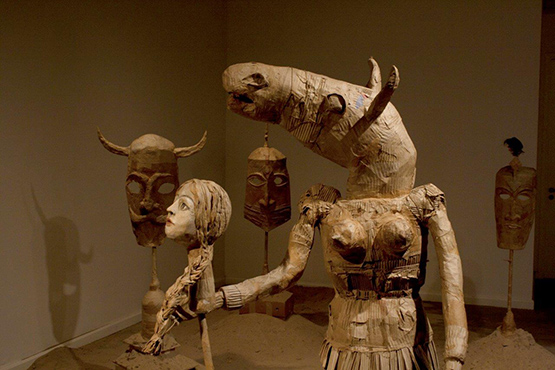
Pulp Narratives
Opening at Aaran Projects on 15th July 2016.

Artists:
Tara Azarm, Leila Imani, Ghazaleh Bahiraie, Fatemeh Bahman Siahmard, Tarlan Tabar, Saman Khosravi, Ali Asghar Khatibzadeh, Afshan Daneshavar, Rene Saheb, Sadegh Sadeghipour, Nastaran Safaei, Kiarash Alimi, Sara Ghanbari, Mina Mohseni, and Masoumeh Mohtadi.

This exhibition aims to show the preoccupations and concerns of a group of artists with diverse practices; Narrations in Pulp that next to each other create a Hall of Mirrors, and consequently a funnel to our times: Nastaran Safaei’s compositions resemble bouquets for an event long forgotten. Pages from a famous women’s magazine of yester years, with pallid and faded colors, enact the theme of life’s transience and fragility. Fatemeh Bahman Siahmard’s large scale drawings create tensions between spatial occupations- actual and imagined- and are charged with energy. Viewer struggles to make the image coherent and through intricate lines artist forces the onlooker to visualize a three dimensional space. Ali Asghar Khatibzadeh who is a playwright transfers his visualizations on to pulp of discarded newspapers. Tragic and comic characters from his favorites writers are moved in to the real world to recite the stories that have fascinated audiences for generations; “Arjasb” of Shahnameh, “Medea” by Euripides and the ever present Clown. Leila Imani focuses her attention on superb delineation in Persian Paintings and by extracting figures from well known imagery of manuscript paintings, offers different readings of age old traditions. Kiarash Alimi’s large scale flowers stand firmly in their isolated world, patient, unyielding and superbly beautiful. The fabulous simplicity of these paintings are a reminder of splendor of life and the plausible lightness of being. Masoumeh Mohtadi creates books that are talebearer of our times. The book speaks of the gloomy disappearance of the ancient lake of the Assyrians, lake Urumieh. The lake that can be the last habitat of Artemia, a 100 million year species that exists as part of the cycle of nature. Unlike humans that disregard the balance of nature for their own ambitions and survival, Artemia, the ancient being, has resisted change. Ghazaleh Bahiraie is a child of our mega city. She has walked the alleys and streets of her beloved city and offers parodies and her own lived experience. Next to her video, her drawings resemble Silhouette Portrait paintings. Through the black and white drawings artist cuts out the cityscapes; tracing lines around the shadows of the city and telling the stories of its citizens. Saman Khosravi takes us back to his childhood. Having grown up in volatile Kurdistan of Iran, and raised amid war and violence, his simple models of aircrafts that are reminiscent of childhood games at schools, is adapted to tell the tale of horrors of war and a childhood that never was. Rene Saheb has consistently used fables and proverbs of our language to criticize and comment on life around her. By bringing the story of Three Wise Monkeys on to paper, she reminds us of the ancient Zoroastrian inbuilt beliefs in all that is good. Mina Mohseni retells the story of the great flood, refreshing the legend of Noah and his survival. The uncertainty of our times and the consistent struggle of humanity against manmade and natural disasters is a large part of the history of the region. Using sheets of wavy transparent plastic to cover her suspended paintings, she forces the viewer to reconsider their perceptions. Afshan Daneshvar, in her delicate compositions and absorbed in her practice, assembles bits of papers that are reminiscent of strings of something that was once was. Re-building a new page, re-assigning morsels and creating a new presence. The final result are Silent and solid entities that are fragile in essence. Sara Ghanbari tackles the subjects of time and memories and how our perception of life changes as time goes by. She illustrates a suspended space: between present and the past. In her twin paintings, she successfully portrays the flow of time and by re-producing the images, she raises the question of vitality and perception of memories, walking on the edge of memories. Tara Azarm with her set of drawings steps in to realm of concept, erosion and passage of time. Her forms seek to establish new structures out of ambiguous circumstances. Her shapes – with no apparent purpose- change from one thing to another and disappear and reappear in a fusion of the real and the imagined. Tarlan Tabar, pictures what she has seen in her subconscious for a long time. In her works Narcissism and absurdity are in conflicting path with eternity and perpetuity. She alternates between agony and ecstasy and offers her interpretation in lively colors as well as in large scale ink drawings. Sadegh Sadeghipour is a book man. His life is spent in a large book shop every day. The books take the shape of sculptures in his intricately hand cut books. If books are to become obsolete in the 21st century, what better alternate than transforming them to a beautiful sculptural piece and keep them around in one way or another.
Navid Salajegheh Presenting two series
“Folded Traces”
“The Castle of Iraj”
And “Winterreise”, A joint project of Studio 51, in collaboration with Bahar Samadi
Opening at Aaran Gallery on 27th May 2016

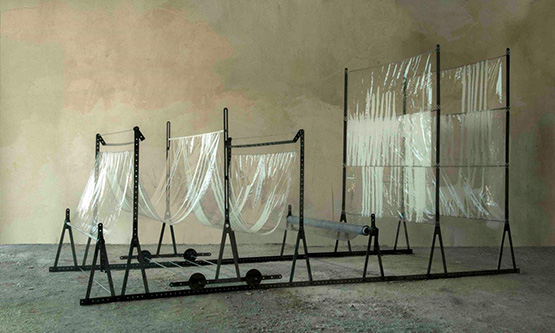
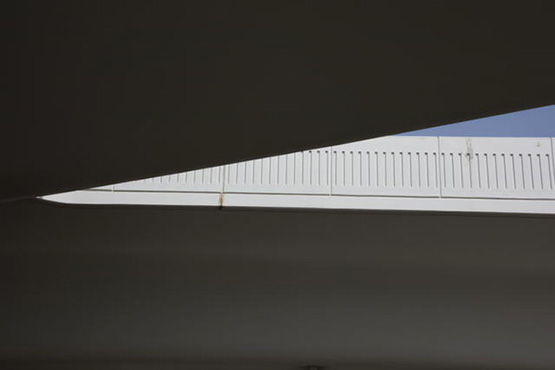
For this exhibition, Navid Salajegheh writes: The two set of works are the result of organized occurrences. The author of both projects has seen it sufficient to create the rules of the game and subsequently he has become one of the components. It is because of this approach that the creators’ act resembles the act of nature. As a result the maker has imitated the nature or in other words has merged with it. In both sets of works, both optical rules and the physic of material is at work. Both leave traces and create incidents; events are made or recorded and these two acts are either removing or adding material, whether it is recreation of the image of ruins, or the re-writing of an assembled archive on a lucid surface.

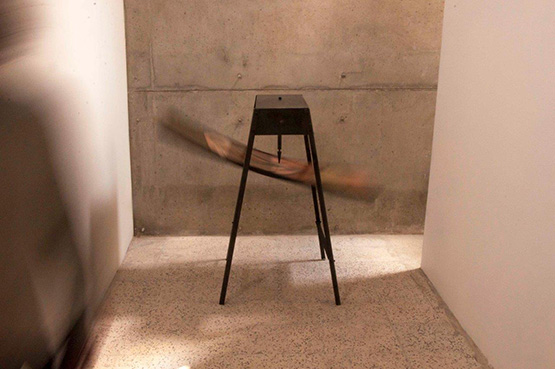
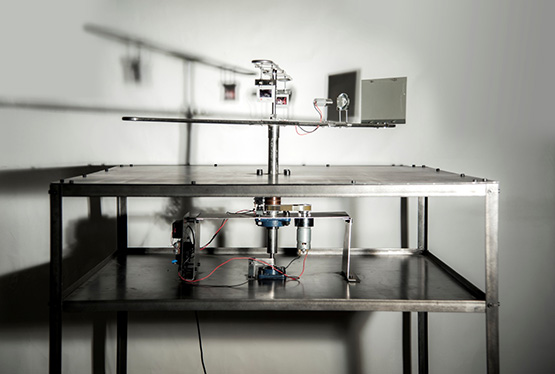
Winterreise, is a project of Studio 51, which is a collaboration between filmmaker Bahar Samadi & Navid Salajegheh. The main theme of their projects is recycling and re-applying preexisting or found and often unidentified footages, as well as textual and visual materials. Studio 51 attempts to rewrite and process these materials various mediums; moving image to performance and installations to painting. And thereby constructing a series of micro narratives which reappear in an alternative time and space. In Winterreise (Winter Journey) Studio 51 creates a mise-en-scène with three different pieces based on a found slide that passes through from one work to another: The film Of Memories of Others, the machine Retrouvaille and the painting in a Snowy Landscape.


Solo exhibition of Yashar Azar Emdadian
Opening at Aaran Projects on 20th May 2016.

This exposition is the result of five continuous years of artistic practice, with concentration on concepts such as identity, borders, psychological warfare, immigration and Paranoia. In this exhibition artist aims to transfer these concepts to his practice and by adding nominative dimension, establishes a direct connection with the audience and offers his own perceptions of some of the most important social and political concerns of a generation that has grown up with two cultures.
The art works presented in this exhibition are not a series but they are all connected and are a continuation of each other. The choice of works and the varied mediums such as sculpture, video, installation and print, are part of artists emphasize on choosing each medium as a fitting format to carry his message through.

Yashar Azar Emdadian, born in 1981, Yashar is born to a family of renowned Iranian artists. He has grown up in Paris and his character is shaped with his dual culture of his home country and his adapted country France. For the past three years he has Moved to Iran and lives out of the Mega City of Tehran. He is born to a family of renowned Iranian artists and having been surrounded with arts throughout his life, He has experimented with different mediums such as print, photography, painting and sculpture. He has worked with artists like Davoud Emdadian, Reza Deghati, Frank Denon and Sylvie Lejeune.


Solo exhibition of Hoda Zarbaf
Opening at Aaran Gallery on 13th May 2016

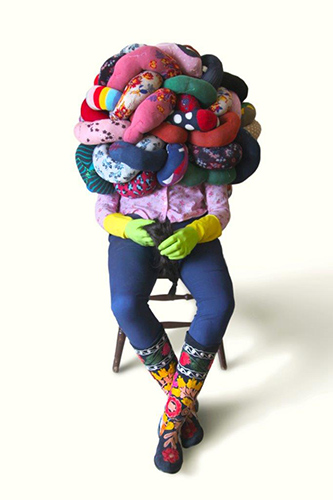
Composed, reshaped and hand-stitched, Hoda Zarbaf’s second sculptural series are made up of old family knick-knacks, recycled clothing, abandoned furniture pieces, stuffed dolls, and the varied artifacts she has gathered while strolling around Tehran.
Titled “Floral Compositions, Travelers of Time”, the sculptures borrow their identity, both in form and concept, from the unity of the dichotomies. Zarbaf has used pre-owned or vintage textiles–along with the traditional folk practice of stitching and patching–to bring a palpable level of intimacy to her work. In her making, the artist marries contrary concepts to achieve the optimum: giveaway and invaluable, pappy and concrete, old and new. Stitches that are both controlled and disorderly unify the soft materials to solid furnishings, creating large figurative sculptures that in a way reconnect the artist to the former and current narratives of her homecoming.
Following her return to Tehran from a nine-year journey in North America, Zarbaf in a new series—created in Tehran—explores the tales of her past life. During this time, she has rummaged through her childhood memories, new family anatomy, as well as solid Tehran daily routines. Abandoned pieces of clothing or old family house items (which have at some point been intimately in contact with the humans from her previous time in Tehran), are married into newly composed sculptures—reconnecting with the past and reminiscent of the lost intimacy.
Moreover, Zarbaf takes her narrative to a new dimension by embedding time-based media such as video, sound and lights in the sculptures. She expresses, in a letter to her friend about this journey, that she thinks these days we are more the travelers of time than of space. She, therefore, leads the so-called floral materials from the past and passes them through the time. To further communicate these passages, metaphorically, Zarbaf interweaves different mediums into each other to further: Industrial wheels carrying a box with stuffed dolls on them; or Soft oozing forms which are stitched around old monitors while exposing human hair or cast limbs.
The collection projects vulnerability while evoking motion—past and present. The soft forms that she has repeatedly created from the floral textiles are mostly remains of her grandfather’s fabric store. Together with the pieces of old furniture, and orphan dolls, Zarbaf has created time travelers that transcend their era and challenge the idea of belonging.


Solo exhibition of Amir Mousavi
Opening at Aaran Gallery on 29th April 2016

The preoccupation of Amir Mousavi with all that is ordinary is boundless. The outside limits of a seemingly simple wall, or a complicated bridge, are the firm elements and the interplay of light and time are the variables; all is calculated to show the indescribable. Everything else is eliminated to create a new subjectivity. Lines along the surfaces of a solid facade meet and capture the imagination of the artist whose fascination with walls of cities is evident in his earlier works. By staring at these surfaces the artist offers that which does not stand upon words. Narration is eliminated and the final result transcends the subject matter. Free from any logic or reason Amir Mousavi offers the depth of his own feelings.

For his third solo show at Aaran Gallery, artist has chosen to show two sets of photographs that stand on Edge and are separated with a ten year time gap. Amir Mousavi is a well known film maker and his earlier photographic works are included in many private collections as well as the permanent collection of Los Angeles County Museum.


Solo exhibition of Hadi Alijani
Opening at Aaran Projects on 22nd April.

The art works of Hadi Alijani, despite their narrative content and delicate humor,communicate a far more important theorem than proposing to explain the works. These paintings demonstrate the complex task of artist in maximizing the application of all aspects of the language of medium of painting. An attempt to utilize the limited resources of this language to achieve composition, coordination between the narration and fantasia, form and ornaments. Art for all time, has struggled to illustrate the subject, whether narrative or not, but the other aim has been to demonstrate the challenge of artist with the concept of beauty. The concept of beauty is farther than observing visual rules and conventions which are limited to a circle of principles. Beauty is about recognizing and forming an assortment of disciplines, relationships or ideas, and part of what artist attempts to do is to purposefully contemplate on how best to attract and fascinate the viewer and hold their attention.
In his recent series, within the frame work of a narrative and visual fantasia, Alijani exhibits his mental and physical challenges. The carefully devised plans, humans and animals in his paintings are indictors of his scrutiny and efforts to merge cubist shapes with forms adapted from Persian Painting. At the same time the minute and dense motives with thick and eroded textures are plainly tangible and physical. As a result of his mindful utilization of the narrative and visual details, his paintings depict a unique world of phantom and beauty, which next to the story line, are representation of the serious challenges of artist in creating his own language and exhibit his dictum on subject of beauty.
Behrang Samadzadegan

Solo exhibition of Kamyar Kafaie
Opening on 15th April 2016

The chronological quality of the elaborate paintings of Kamyar Kafaie covers diverse subjects. Infused with sly humor, they reflect our society’s past and present. By adapting a flamboyant and accessible aesthetic, he criticizes the behaviors of the middle class of Iran. Some paintings have autobiographical references, and some are commentaries on the hypocrisies of society. Characters are developed in his sketch book and are transferred onto canvas, and more often than not same characters appear in different paintings. Serious Environmental issues that the country faces are one of the traits in his paintings, as are historical and current social events. In his Radioactive Library, every painting is a book that tells its own story. The narrative flow of these intricate scenes is reminiscent of the fabulous manuscript paintings of Persian art of book making.
The daily strains of life in Iran and undue pressures from the outside world are easily detectable in our current art scene. Kamyar Kafaie prefers to turn away from the negativity and show other aspects of life in Iran. Like many Iranian artists and poets, he chooses the language of satire to deny darkness. He paints his surroundings and creates his own allegorical and alternative universe where he is allowed to push the boundaries.


Persian Gardens
Opening at Aaran Projects on 8th April 2016.

Artists:
Fereydon Ave, Hadi Hazavie, Shirin Neshat, Mandana Moghaddam, Arita Shahrzad, Behdad Lahooti, Bita Ghezelayagh, Hadi Alijani, Ghassem Mohammadi, Tanaz Amin, Ziba Rajabi, Hadith Fakhr, Parisa Taghipour, and Hamid Arabi.

Here in this carpet lives an ever-lovely spring; un-scorched by summer’s ardent flame, safe too from autumn’s boisterous gales, mid winter’s cruel ice and snow, still gaily blooming. Eyes hot-seared by desert glare find healing in its velvet shade. Splashing foundations and rippling pools, in cool retreats sore-wearied limbs restore, and tired hearts awake with joy once more. The way was cruel.

Baffled by monotony and mocked by phantoms delirious, beset by stalking death in guises manifold; The dreaded jinns, the beasts ferocious, the flaming heat and the exploding storms; form all these perils here at last set free; in the Garden all find security.

Here the long-laboring Earth at last gives birth. From apparent death, a new and lovely world is born; below the desert’s dusty floor, the jacinth imprisoned lies. The stony wilderness so bleak and bare, in ageless patience broods, aware of a life within, the promise of fertility and abundance. Ever longing for deliverance. The world at last reveals its destiny.

Can we not then capture and restore the loveliness that gave us hope, still brightly mirrored on memory’s gliding waters or snared in the poets’ invisible net, so wide, so fragile, yet captor and conqueror of realities elusive?

Wrought in gold and azure, bright as carved metal. Dream-like foliage in sparking tones is caught, or else, in sumptuous shades of glossy lacquer, quiet but intense; in muffled browns and honey pure, jasper cool and mellow cinnabar, that fairy land comes real again.

In sudden collisions find sweet embrace; in rhythms enchanting, with stately pace, or rollicking speed; emerging, retreating, Reversing, in peaceful finality. Their conflicts reconcile, all in confederation blending Like a chorus in part-song gladly singing, in contrapuntal play rejoicing, floating soft or wildly free; yet anchored in eternity.


Fearless, The Next Wave of Artists from Iran
Curated by Fereydoun Ave

The exhibition will be held simultaneously in Tehran and Dubai.
Opening at three spaces in Tehran on 11th March at Aaran Projects, O Gallery and Lajevardi Foundation. And at Total Arts, Courtyard in Dubai, on 14th March 2016.

List of artists:
Sara Abbasian – Sasan Abri – Nasser Bakhshi – Reza Bangiz – Afshan Daneshvar – Habib Farajabadi – Soussan Farjam – Nariman Farokhi – Farhad Gavzan – Kasra Golrang – Mohamad Hossein Golamzadeh – Vahid Hakim – Hadi Hazavei – Mehrdad Jafari – Ebrahim Khadem-Bayat – Nogol Mazloumi – Arsia Moghadam – Amir Mohamadzadeh – Omid Moshksar – Kaveh Najmabadi – Farokh Nooroney – Mehrdad Pournazarali – Ali Razavi – Ashkan Sanei – Baktash Sarang – Sadegh Sadeghipour – Sharvin Shahrokh – Sepehr Mesri – Mohamad Reza Yazdi – Hossein Ali Zabehi – Zahra Navaie – Parichehr Tayebi – Pourang Pirataie.

Fearless is about 33 artists from Iran who have been working and working regardless of the market’s madness because they are manically obsessed with what they do. These 33 artists have been expressly chosen from various generations, from 25 to 75 years old. There is no age for being an obsessive courageous lunatic working silently.
“It is always hard choosing 33 artists from so many unsung heroes but it has to be done so apologies for not having enough space to include everyone.” Says Fereydon Ave, who has carefully selected pieces by these artists. “None of these artists have had media or market attention because of their obsession with work and not personal hype, so I am glad to champion them.” In a time and space where nothing changes fundamentally to keep on working on personal visions is fearless and to see fear as the only real censorship is to come out of the shadow.
The paintings, photographs, sculptures and installations in the exhibition encompass both figurative and abstract works, different in style and medium, and created by artists drawing on vastly different social, political and stylistic influences. Fereydoun Ave


Shahnameh, The Perpetual Narrative

The exhibition is based on a survey of the impact of Shahnameh on Modern and Contemporary Art of Iran conducted by By Akram Ahmadi Tavana. A fully illustrated catalogue is published for the occasion, with Foreword of Dr. Firuza Melville, Director of Research, Shahnameh Centre for Persian Studies, Pembroke College, Cambridge.

Opening at Aaran Gallery on Friday 4th March, 2016.

Artists:
Arabali Sharveh, Nikzad Nodjoumi, Mehdi Hosseini, Gizella Varga Sinai, Fereydoun Ave, Marziyeh Garadaghi, Farah Ossouli, Taraneh Sadeghian, Shirin Neshat, Jamshid Haghighatshenas, Saeed Ravanbakhsh, Reza Hedayat, Behnam Kamrani, Yasaman Sinai, Alireza Jodey, Siamak Filizadeh, Amir Hossein Bayani, Ala Ebtekar, Artemis Shahbazi, Ali Reza Fani, Mahsa Kheirkhah, and Aylin Bahmanipour.

Simultaneously on Friday 4th March up to 6th March, between 5-8, an enactment of performance of Mohreh Sorkh, of Saeed Ravanbakhsh, first performed in 2001, will be presented at Aaran Projects.

The appeal of Shahnameh for visual artists, which began two centuries after its creation, has remained solid and in contemporary times continues to be an inspiration for creation of art. The reasons and motives of artists in choosing this subject and their artistic interpretation, has been diverse, due to social, political and cultural contexts of their times. The two alternating approaches of emphasizing either on Iran’s Ancient history, or its Islamic history, can explain different attitudes of regimes; while under the rule of Pahlavi dynasty production of art on the subject was encouraged for official events, but in years proceeding the Islamic revolution, and despite the anti-Shahnameh sentiments of the first few years, artists, whether individually or collectively, have referenced Shahnameh in a completely independent approach. Artists have been drawn to the magnificent abilities of the Epic Poet, Ferdowsi in visualizing the battles and even romantic scenes. Not withstanding the exalted position of Shahnameh as a constant source that recalls the glory and magnificence of Ancient Persia, generations of artists have alluded to its stories to criticize the cultural and social inadequacies.
For centuries Persian artists have used mythology and poetry to depict a wondrous world, loyal to ideals of beauty, truth and perfection. A world where they have found the redeeming answer to brutality chaos and frustration that seems always to have been a part of daily life. Artists have created sanctuaries, providing consolation, delight and revelation for their audiences. They have preserved a Persian legacy, enriched our lives and inspired us as a nation to become better than we are.

We are grateful to the Iran Heritage Foundation for being a sponsor of the exhibitions’s publication.


Limited Access, The Sixth Edition
A festival of moving image, sound and performance.
Parkingallery Projects in collaboration with New Media Society and Aaran Gallery.
The event will be held at Aaran Projects, between 26th February to 2nd March 2016.

Limited Access, as an independent mobile and non competitive project was introduced in 2007 and in the past eight years has been held in Tehran, Cairo, London, Mashad, Shiraz and Esfahan.
Limited Access refers to the fragmented structure of the New Media art scene in Iran, and endeavors to be a platform for assembly, international exchange and screening of rarely seen art works in the field of Moving Images (Video, Documentary, shot film, animation, and independent Cinema), sound art and performance..

In the sixth edition besides “the archipelago” video program curated by Amir Ali Ghassemi – a blending of open calls and invitations-, various video programs Selected by International curators, will be screened.

“Out of The Box”, curated by Alessandra Pace, lecturer, curator and art historian based in Berlin, is an assemblage of phenomenal video artists who continuously expand the confines of this media.
The collection “VIDÉOGRAPHE IN TEHRAN” ”, selected by Audrey Brouxel & Karine Boulanger, from Montreal, offers examples of notable trends of video art in Quebec.
Marika Kuźmicz, who will be traveling to Tehran for the purpose, will be presenting and introducing the Polish Avant Garde video art of the 1970s.
Sanaz Mazinani and Mark Mayer, by presenting “Physical Limits”, question the physical and psychological limitations of the body, from daily domestic routines to the pressures of conforming to societal norms.
Limited Access Six, will be completed with special screenings and related talks and few installations, will be on view until 2nd March.

The daily program will be posted on: www.limitedaccessfestival.com


Solo exhibition of Nasim Davari
Opening at Aaran Gallery on 19th February 2016

That which is new, is incredible and astounding, so says Nasim Davari for her second solo exhibition. In second set of works that fall under the same title of her first exhibition, she once again offers glimpses of her humanity, a world that is constantly evolving. She continues to defy our aesthetic perceptions with her new hybrid forms which are part of her personal cosmology. This plenitude of details and the connection between the paintings is the result of her meta mythical fantasia, one that she insists is not strange, and that all new things are only strange at the moment that they are created and viewed.
Her bizarre world is a colorful one. The vivid colors that are now an essential part of her practice, are soothing and strong and unique. She proposes a parallel world of mystery and fantasia and deep compassion. It’s best not to try and explain this magical world but to float in the wonder that she creates. Stepping away from these paintings the world is once again factual and mundane.


Solo exhibition of Myriam Quiel
Opening at Aaran Gallery on 5th February 2016

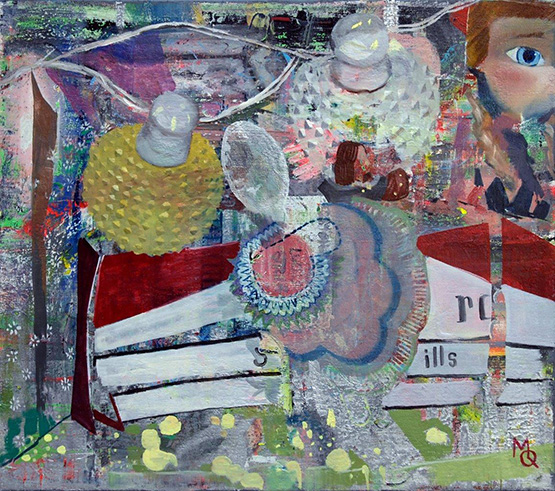
Myriam Quiel’s paintings are depiction of fragments of the circumstances she lives in.
She combines certain impressions of her daily life and by using unimportant objects, she expresses her feelings and her state of mind. The question is always about reality, and how she confronts the realities of her life. The objects that she paints are familiar and in combination create collages that reflect her experiences. She does not attempt to tell stories through her paintings, but rather keeps her stories hidden and well covered, leaving the audience free to make their own interpretation.
She paints Still Lifes, that are chaotic and out of focus, unsteady and indefinite. The fragments of the paintings are meticulously chosen and placed next to each other, but the final work has an unfinished quality, a never ending story. By destroying and rebuilding, she offers a status quo. Her intension is not to search for harmony but to show the unsteadiness of our times. By using trash, discarded toys, withering plants and finally distorting them, she gives a picture of a frozen time. The unfinished state of everything interests the artist, leaving open structures for her to continue painting.
Her Still Lifes are an artificial world, snap shots of the flood of images that surrounds us, in other words, leftovers from daily life stories. She stabilizes abstract patterns in contrast to blurred shapes and draws the gaze of the viewer to her environment. An inanimate world, with commonplace objects, that questions the permanency of life and its realities.

Born in Germany in 1974, Myriam Quiel is a German-Iranian artist based in Tehran. She studied painting at the Academy of Fine Arts in Dresden and graduated in 2003. She started her career in 2004 in Berlin and her work has been shown in a number of German galleries. Since 2008 she has settled in Tehran and has held two solo exhibitions in Tehran and her latest solo exhibition titled PIN-UP was organized by Munikat Art Gallery, in 2013.


Opening at Aaran Projects on 29th January.

This exhibition is dedicated to ten of the leaders, activists and journalists who were brutally murdered during the Constitutional Revolution in Iran (1905-1907). Their names are engraved on conscience and history of this country:
Mirza Reza Jahangir Khan Sour Esrafil – Journalist
Sheikh Ahmad Rouh ol Ghodos – Journalist
Malek ol Motekalemin – Leader and Grand orator of Constitutionalists
Ghazi Ardaghi – Activist
Mirz Ebrahim Agha Tabrizi – Member of Parliament and Journalist
Seyed Jamal ol Din Vaez Esfahani – Leader of Constitutionalists
Sheikh Ahmad Rouhi – Activist and Journalist
Seyed Mohammad Tabatabaie – Leader and Activist
Saqat ol Eslam Tabrizi – Leader and activist and Author
Prince Yahya Miraz Eskandari – Member of Parliament and Journalist

The Persian Constitutional Revolution took place between 1905 and 1907. The revolution led to the establishment of a Parliament in Iran and opened the way for cataclysmic changes in Persia, heralding the modern era and the rule of law and promising freedom of speech.
The monarch Mozaffar ad-Din Shah signed the constitution in 1906, but he died shortly after and was replaced by his son, Mohammad Ali Shah. The latter abolished the constitution and in June of 1908, with support of British and Russians, bombarded the Parliament. Russian colonel Vladimir Liakhov who was the commander of the Persian Cossack forces, formed as a elite cavalry unit in 1879, lead the forces in shelling the Majles, killing hundreds of people and later on executing leaders and Journalists of the Constitutional Movement. The Shah kept himself confined to his residence at Bagh-e Shah fort in west of Tehran. A number of captured constitutionalists were imprisoned at Bagh e Shah and tortured and killed.
In retaliation and by July 1909, pro-Constitution forces marched from provinces of Azerbaijan and Gilan towards the capital and were joined with forces of tribes of Bakhtiari and Qasqai. They were able to capture Tehran and re-establish the constitution.
On 16th July 1909, the parliament voted to place Mohammad Ali Shah’s 11-year-old son, Ahmad Shah on the throne. Mohammad Ali Shah abdicated and fled to Russia, later to Turkey and died in San Remo Italy. Every Shah of Iran since Mohammad Ali Shah has died in Exile.


Solo exhibition of Mehran Saber
Opening at Aaran Gallery on 22nd January 2016

Paintings of Mehran Saber appear to be reactions to an apparently meaningless world, not controlled by humans, and influenced and even menaced by an invisible outside force. Shapes that are stretched, distorted and caught in suspended situations as if they are forced to do repetitive and meaningless actions. In his works, reality is dismissed and even Surrealism is distorted.

Hybrid creatures, often twisted and pressured, push and pull, apparently in a vicious circle and this time around water. Artist portrays the realm of unconsciousness and points to its indecipherable and vast expanse. A world devoid of every day restrains and limitations. Forms appear to be liquefied to transport the viewer to the limits of absurdity, completely out of tune and at the same time believable. The fabulous color palette is wild and exuberant, attracting the viewers at first glance and then challenging them into submission to observe the beauty and harmony of colors, while proving to them that the paintings are truly marvelous as well as wonderfully beautiful.


Solo exhibition of Morteza Pourhosseini
A project in collaboration with Nader & Nader LLC. New York
Opening at Aaran Gallery on 8th January 2016

By applying his significant technical skills, Morteza Pourhosseini, builds a bridge between artistic practices of the present to those of the past. His paintings are realistically detailed and signal his precision and focus. He captures details to hint at the mysteries behind the image. While he is inclined to stay away from registering emotions, the underlying strain and volatility are evident in each of these timeless portraits; particularly the hands that in proximity of various objects betray the tensions that are part of the rigidity of the poses. Elements of history of art are boldly incorporated in the paintings to emphasize the content and advocate skepticism and critical thinking. The narrative concept points to humanism and agency of human beings. The existential angst is evident in these portraits and while artist unfolds age old questions, he refrains from answering them.
Confronted with the realities of the world, such as violence, the dilemma of Either/Or is as complex as it was when Kane and Abel walked the earth. To prove that a suggestion or an idea is true or false is very often not attainable. The answer to the perpetual question of how we should live is a unfathomable as it was centuries ago. Logic indicates that nothing can be known for certain but senses are easily fooled and reason is outwitted by human desires. What is known for sure is that human beings are condemned to be free, to carry the dilemma of uncertainty or in other words the burden of choice, and are ultimately responsible for everything they do.
Born in 1985 in city of Ahwaz, Morteza Pourhosseini studied painting at Shahed Art university in Tehran. His work has been acquired by the Metropolitan Museum of art for their permanent collection in 2014. His third solo show titled “The Circus” was held at Bohemian National Hall in New York in the same year and he has participated in various group exhibitions in Iran and abroad.


A selection by Behrang Samadzadegan and Aaran Gallery
Fereydon Ave – Hossein Valamanesh
Shaqayeq Arabi – Hamid Arabi – Mohamad Eskandari – Nasser Bakhshi – Fatemeh Bahman Siahmard – Sahand Hesamiyan – Elaheh Hosseini – Baktash Sarang Javanbakht – Amir Nasr Kamgooyan – Shirin Mellatgohar – Nogol Mazloumi – Hooman Mehdizadeh Jafari.
Opening on 25th December at Aaran Projects.

Works assembled in this exhibition are product of poetic subjectivity of their creators; works that travel through time and space and are unrestrained by the realities of the world. Defying gravity (both as a natural force and in complexity of situation), in form and concept, these group of works suggest motion and fluidity and by blending what is stable and what is mobile, gracefully portray the uncertainties of our era and world in general.

The lyrical force of Iranian art and its gentle allegorical curves are part of the concept of this exhibition. The interaction of shifting elements, resembles the balancing act inherent in Persian poetry; the lows and highs, the melody and pace, the harsh and the soft. Forms move through time and space and return to the real world as artistic actualities, ultimately reaching a stability in which all forces are equal.

A number of artists present in this exhibition are known for their exalted style and progressive attitude, next to them we are show casing works by younger artists who are unconventional and unrestrained in their practice. The constellation of these set of works is an attempt to reveal part of what is true and persistent in Iranian art today; a boundless potential for ecstasy and agony, a consistent struggle to deny darkness and to progress despite obstacles, in other words a balancing act.


One of the distinguishing aspects of my practice is to challenge observation and visual perception. Subject matters that I choose vary from contemporary issues to classical art. References to art history and the history of seeing are inseparable to my art. Yet, I do not put art history on a pedestal as references are not there to be praised or to give joy; they rather work against each other. That is why details are so important in my work. Each of my works has a different subject matter as I do not make series. Recently I mix painting and sculpture with mechanical machines that question the nature of painting and sometimes go against the nature of creation and even ruin it.

Shahryar Hatami
December 2015


Bits And Pieces
Curated by Amir Ali Ghassemi
Opening on 27th November 2015 and will be on view until 17th December.

Presenting works by:
Talieh Kamran
Jan Matavoussian
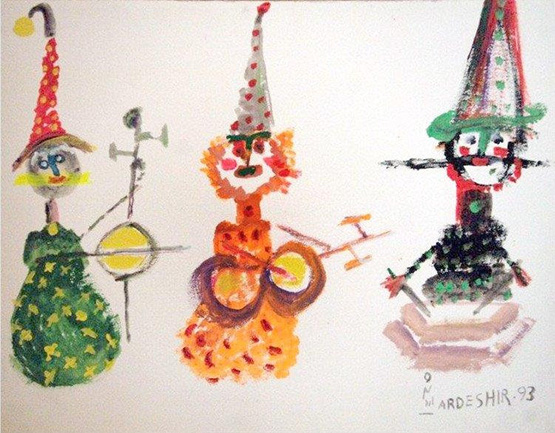
Ardeshir Mohasses

And artists present:
Abbas Badihi – Yousha Bashir – Amirali Mohebbinejad – Alireza Malekian – Ayeh Rahimi – Bahar Vafaei – Farshad Nekoumanesh – Hooman Alizadeh Sani – Tannaz Daneshmand – Kiyan Forouzesh – Maede Jenab – Mahtab Alizadeh – Navid Salajegeh – Nazanin Aharipour – Nima Bahrehmand – Reza Behzadnia – Simin Yaghoubi – Sadegh Sadeghipour – Amir Amiri – Aydin Samami Mofakham – Martyna Kosecka – Nastaran Safaei – Saman Khosravi.

Bits And Pieces, is a collaboration of New Media Society and Aaran Gallery, that attempts to depict a world that is fragmented and floating between various medias. In the process of selection for this group project we have searched for artistic approaches that are experimental and playful in their core with parallel and intersectional tracks: works on paper and collages combined with concrete poetry, scenery juxtaposed with memory, performance in conversation with sound, video footages that combine bits and pieces, and sculptures/found objects that are gathered from the city.

The exhibition itself is a collage of generations and their different approaches and takes shape in different layers: works that have just been created and projects that have long been forgotten. Bits And Pieces, is completed with Performance, talks about Sound Art, and art in public sphere, and animation screening. These events are planned to frame the extended edges of the spirit of this open ended project.

Amir Ali Ghassemi


Presenting works by Malakeh Nayiny and:
Alireza Adambakan – Ala Ebtekar – Mohammad Eskandari – Asghar Aharipour – Mehrdad Jafari – Azam Hosseinabadi – Hamid Hemayatian – Nasim Davari – Maryam Sepiyani – Nastaran Safaei – Emitis Abbassioun – Shirin Fathi – Hadis Fakhr – Reihane Taravati – Farshid Larimian – Dehghan Mohammadi – Allahyar Najafi.

Opening at Aaran Projects on 20th November 2015.

In Arts, liberated from constraints of reason and logic, artists conceive and combine new forms that enrich our lives, in mythology too, we entertain a hypothesis, to perhaps find answers and solutions to our world which essentially is a puzzle. What if this world were not all that there is?

Humans beings are unique in retaining the capacity for play and amusement. More often than not we forget this gift. The power of imagination which forms our mental image of something that is not perceived through the five senses, should not be underestimated. It is essential to recognize the importance of this force that breaks down borders and teleports us beyond our circumstances, and abilities. A world of wondrous charm and endless stories, unrestrained fancy and extremes that challenge belief.

The artists working in the realm of fantasy, violate in a variety of ways, standard expectations by drastic experiments with subject matter, form and style. Constant fusion of every day with the fantastic, mythical and nightmarish. These trail blazers render a world that blurs traditional distinctions between what is serious, trivial, horrible, absurd or tragic.

Once upon a time, Lamassus and Griffins guarded the Capital city of Persian empire, they still do. An echo of a time where kings were transported to the sky by giant birds, and snakes growing from man’s shoulders feasted on human brain, and the white Div was defeated by the super hero and Simorgh was busy saving the albino child. A recurring magical abstractness that permits representation to take a timeless character; recalling the past, expressing hope for future and affirming continuity.


In his new series Sasan Abri utilizes color to express emotions. A choice to communicate basic human feelings that are portrayed and not explained. He delves in to the world of nature and picks one color. Like all monochrome works of art, this collection floats in the realm of emotions, where differentiation is impossible; a world of fullness and void where time is obliterated, and purity of color invites the viewers to contemplate and take one moment away from the hectic world and to stare at essence of being.
For catalogue of exhibition artist writes:
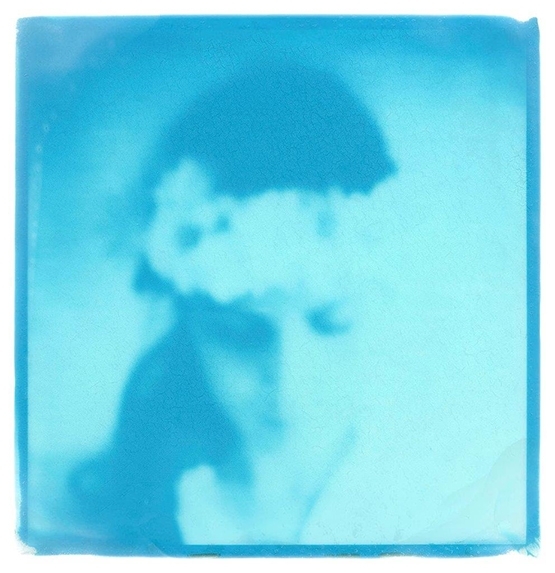
I have always looked for a haven in nature. Nature that is glorious and unpredictable and has thousands of colors. In this mass of colors, a certain color appeared in the depth of my psyche and my vision and it was transferred to the sensitive surface of film. A color that was protruding from inner depths to the exterior: Blue. And not the familiar blue, but a radiant blue which was streaming from the depths of my being and it should be called “The Ultra Blue”.
This blue is a plenary color. A finely formed color that has slowly walked in to the camera. After mixing with other colors, it slowly emerged from the depth of life and gradually and after mixing with a wide spectrum of different lights and shades, it finally settled on paper.
Patterns merged with visages and made the blue portraits. The ultra blue for me is the embodiment of the infinite simplicity of life and its meaning. A meaning that is Anthropomorphic and a beacon of hope which radiates from every living being and it is dynamic and if you look deep enough it is constant and repetitious.


In collaboration with Iranian Association of Sculptors

The very large or “colossal” statues have had an enduring appeal since ancient times, and so does small sculptures, which as personal possessions or small figurines of deities have been found all over the world.
Artists have been commissioned to create large splendid sculptures to mark events and mainly to “exhibit” power and wealth. On the contrary , generally, small sculptures have been for personal use, entwined with personal attachments, and mostly are result of impulses and desires of their creators. Throughout history refined and delicate small statues have invoked positive reaction from the viewers, who find them more appealing and intimate than the glorification that is inherent in grand sculptures. Despite their sizes the small sculptures are often more admired than large scale pieces, because of the fact that the craftsmanship in a small scale is harder to achieve, there is hardly room for error and therefore patience of the creator is always admired.
For the 9th Exhibition of Small Sculpture, 45 artists will be exhibiting their works. Works that cover a wide and appealing array of subjects and materials. What is common in these sculptures is the personal and informal approach, a sample although Small, of the personal language that each artist has applied to reveal their emotions and reflections.
In this selection, ordinary and extraordinary events are touched upon; burning of stray cats along with their guardian in a freak accident (Burnt Cat, by Elnaz Ghaemi), pleasant time spent in Manuchehri House in Kashan (by Sam Nikmaram) to yesteryears and popular women’s magazine (by Nastaran Safaei), to fragility of life (by Massih Moshtaghi)…
This exhibition is a sample of different approaches and practices of Iranian contemporary artists who are persisting on their individuality as any other contemporary human being and showcasing what is spun from the heart and woven from the soul.


Solo show by Sara Ghanbari

For her first solo show Sara Ghanbari tackles the subjects of time and memories and how our perception of life changes as time goes by. She is preoccupied with nature, and that has led her to paint on leaves and to bring in landscapes in to her paintings. In this series she illustrates a suspended space: between present and the past. In her twin paintings, the first image is painted and in the second Act, the final result is painstakingly printed with paint thinner process, and the crumbled leaves are inserted. She successfully portrays the flow of time and by re-producing the images, she raises the question of vitality and perception of memories, walking on the edge of memories.
Presence of light is evident in these paintings and is emitted to the viewer. The lightness and fragility of paintings makes them intimate and accessible to everyone; a delightful walk in the forest, a dip in the pond, a walk in the snow. The interaction between presence of light and subject matters results in almost transparent images. She honors and exalts simple acts of life. These paintings take their origin from emotions recollected in tranquility. A course that artist has chosen to heal wounds and by title of exhibition she promises to cherish and glorify the remainder of the days.


Opening at Aaran Projects on 18th September.

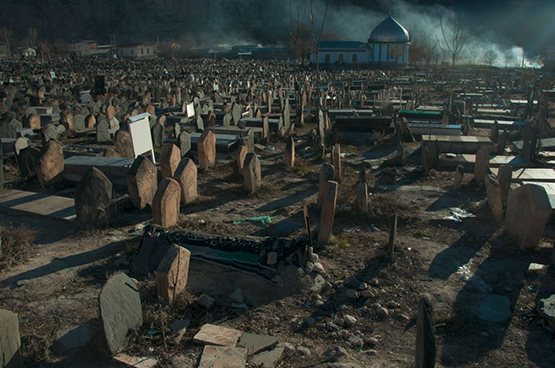
I am a taphographer, I make grave markers, for the past fifteen years I take pictures of graves and burials and I make frottages on epitaphs of those eliminated only to distribute them. I have also made cenotaphs. Memorials too, for the dead and the living. All these frame Curriculum Mortis. It is true to say that Curriculum Mortis is not a series. I cannot make series. Certainly one can categorise these works as broken gravestones, mourners, survivors, the anonymous, the killed, perpetual and ephemeral grave markers, the living and the dead and even a set of graves and memorials that like Flemish vanitas paintings have snails crawling on them. But in this volume there are works that are included in the exhibition and there are also works that are not. They are not included, because, they are not here, they are in cemeteries or are cenotaphs or memorials now residing in museums or in someone’s house, or I am forbidden to show them or they should not be here. On the other side, in the exhibition there are things that are not included in this publication. And there are things that are neither in this publication nor in that exhibition. This is what curriculum stands for. A curriculum is an account, it is a course. Each of these show one moment of this path. For all this, all I publish or show should bear this name. And so far there are one other exhibition and two publications by this name. I assume this would be the case forever.
Barbad Golshiri


Opening at Aaran Projects on 18th September.

Group installation exhibition and performances curated by Amir Ali Ghassemi

Artists: Atoosa Pourhosseini, Navid Salajegheh and Bahar Samadi

Semi-Dark Room is a group installation exhibition & performances taking place at Aaran projects in the last days September. The exhibition includes the installation experiences in the field of «Expanded Cinema», «Performance Art» and «Moving images installations» by the artists.
In «Semi-Dark Room» a limited source of light partially lightens the room. Light passes through series of intervening filters that sometimes depict images and at other times contain memories. In the meantime the devised machinery are important passages that regardless of their obvious logic, operate and implement changes and alterations that are for and against perception.

Semi Dark Room is part of a project titled “The Luminous Void”, other programs of this project will be on view at Lajevardi Collection and Darbast Platform. For More info and data please visit website of “New Media Society”: www.newmediasoc.com

Bahar Samadi (b.1981, Tehran)is a Tehran Paris experimental film maker.
She studied architecture in Azad University of Art and Architecture in Tehran, Iran (2006) and graduated in Filmmaking from EICAR university of Paris, France (2012).

Navid Salajegheh (b. 1981, Tehran) is a Paris based architect, urban designer and visual artist. He received his MA in Architecture from Azad Art and Architecture university of Tehran and graduated in “Architecture: city and urban project” from L’ecole nationale d’Architecture de Marseille, Marseille/France. Together with Bahar Samadi they have started Studio 51.

Atoosa Pour Hosseini (b. Tehran 1981) is an artist based in Dublin/ Ireland. She holds a
MA in Fine Art Media from National College of Art and Design, Dublin (2014), as well as BA
in Fine Art Painting at Azad University of Art and Architecture, Tehran (2007).


Solo show by Naghmeh Ghassemlou

Aaran Gallery is pleased to present latest works of Naghmeh Ghassemlou. The new series of works circles around time, and how the passage of time shapes our identity. In this highly personal series, Artist whose earlier series of works are part of permanent collection of LACMA (Los Angeles County Museum) and TMOCA, (Tehran Museum of Contemporary Art), merges her own photographs with that of her father, Reza Ghassemlou, who owned and operated “Photo Asia Shop”, in Tehran between 1950s to 1970s.
She writes: The first image of the series “Me, And My Dad”, is the result of years of probing and playing with my father’s photographs, and the idea of finding a way to connect moments of his life with mine. The challenge was to maintain the entirety of image, by connecting two separate photographs taken at two different times and places, and to connect them in a way that the least amount of separation is evident to the viewer, in other words the points of excision and connection are of outmost importance and this was my main concern. Neither of images were meant to come together, but were chosen from archive to create a third image. Although the contents of the third image are taken from the two photographs but the result is neither the first nor the second photograph. The new image has its own meaning and identity and independently stands on its own merit.


Opening on 21st August 2015 at Aaran Projects.

A selection by Behrang Samadzadegan and Aaran Gallery

Artists present in this exhibition:
Marcos Grigorian – Kamran Diba – Mohammad Hossein Emad – Mostafa Darebaghi – Korosh Ghazimorad – Mahmoud Mahroumi – Sahand Hesamiyan – Barbad Golshiri – Mona Aghababee – Reza Sedighian – Masoumeh Mohtadi – Samaneh Motallebi – Reza Eshlaghi – Aliyar Rasti – Shabnam Lohrasbi.

Historically in practice of Iranian artists -excluding possible exceptions- the lyrical, thematic, narrative or message orientated, have been the essence of creativity. All kinds of themes; phenomenal, political, social, literal, emotional, narration, and transcendent experiences, have always been at the core of artistic practice. Once the Iranian artist approaches a minimum state, such as a white or black rectangular, the process of creation leads to a rectangular of “nothingness”, or saturation of “blackness”. When they apply the repetitive geometrical shapes, the fractal is expanded in an aesthetic discipline. If they reach the black rectangular, it’s not a sign of Minimalism, but it’s in accord with the Duchampian effect of “Art is no more retinal”; Very often this same artists reach the state of “non written”, or saturation that is an indicator of incapability of language of art to carry the load of the mind.
Rhythm in many aspects of “outwardly minimal looking works of art” has a narrative scope. Because it is joined with motives that are neither necessarily minimal nor are meaningless shapes. Many of our artists are “narrators of elimination”. There are concrete cubes that hide historical tragedy. And drawings that are self exploring, methodical and minimal but playful. Or in practice of Marcos Grigorian, who after Auschwitz arrives at nonexistence and void. Or in paintings of Kamran Diba where after the elimination of news -the cover up of knowledge-, the text converts to rhythmic bulks of color. Or in works of Emad the act of elimination in conjunction with the lyrical mentality of artist, results in “deduced” forms. It’s no more possible to observe and judge the work of art without referring to the context and author’s wishes and concept. It is essential to expand the perceptions and avoid labeling of works of art. And here is the subtle point of differentiating between two concepts of “Minimal and “Minimum”. All the works presented in this exhibition are related, in the sense that with “Less” they say “More”…
Excerpts from catalogue by Behrang Samadzadegan

Group Exhibition


Participating Artists: Artists present in this exhibition: Sasan Abri, Asareh Akasheh, Tannaz Amin, Maryam Amir Farshi, Ghazaleh Bahiraie, Nasser Bakhshi, Dadbeh Basir, Majid Biglari, Parinaz Eleish, Ebrahim Eskandari, Mohamad Eskandari, Yashar Azar Emdadian, Maryam Espandi, Farhad Fozouni, Kamyar Kafaie, Amir Nasr Kamgooyan, Myriam Quiel, Amir Mousavi, Aliyar Rasti, Navid Rasouli, Zarvan Rouhbakhshan, Romisa Sakaki, Behrang Samadzadegan, Bahar Taheri.

You are cordially invited to attend the opening of the group exhibition titled “Tehran: Virtual or Real,” which will take place at Aaran Gallery, marking the launch of “Aaran Projects.”

The new space is located at No. 5, Lolagar Alley,, Neauphle-le-Château St.

The event will be held from 4 PM to 8 PM on July 18th and 19th, 2015.


Solo show by Mohammad Eskandari

Eskandari’s Butterfly Stickers
By Talinn Grigor

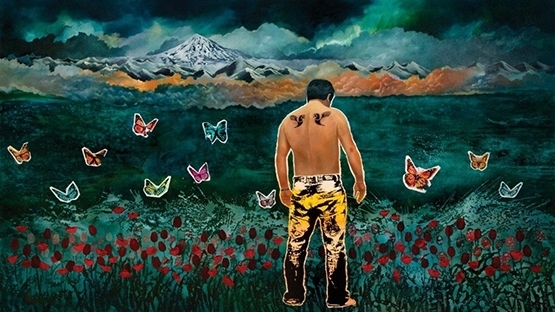
There is a simultaneous sense of futurity and historicity in the five large canvas paintings, and one video work, by artist Mohammad Eskandari. His superb mastery over the brush comes from having been born into an artistic family as well as a successful artistic education and career. Yet, these images are not merely an outcome of skill and upbringing. Through that inheritance, these works convey a deep insight into Iranian history, Iranian symbolism, Iranian modernity, Iranian wealth, and Iranian pain.On these canvases, Eskandari embraces the Qajar and Pahlavi pardeh khani tradition. An old Iranian artistic method, that I would trace even further back to Sassanian rock-cuts, portable paintings on large canvases (pardeh) used to illustrate the Battle of Karbala, Koranic stories, and the epic of the Shahnameh. Reviving the large-scale technique, the artist invokes other forms of historical accounts that speak so clearly about a tentative future. Thus, Eskandari selects fragments of rich architectural and geographic past: a gate, an Eyvan, a summit, and a forest collide into a future shaped by human agency that remains unresolved. Historical monuments, national symbols, fragments of natural landscape, and separate figures all hover on the painterly surface – somehow in a state of constant flux, a state of abstraction and foolishness that makes total sense. The painter speaks to his audience. The painter invites his viewer to inhabit a space of ambivalence and absurdity… a place that goes somewhere but that is certainly irresolute…
Excerpt from text by Talinn Grigor for catalogue of exhibition

Talinn Grigor (Ph.D., MIT) author of the book “Contemporary Iranian Art: From The Street To Studio”, is an Associate Professor of modern and contemporary architecture in the Department of Fine Arts at Brandeis University, Boston. Her research concentrates on the cross-pollination of architecture and (post)colonial politics, focused on Iran and India.


Solo show by Nima Alizadeh

Doonadoon, or “Jameh beh Jameh”, is the circulation of soul from one shell to another one, whether human, animal or vegetal.
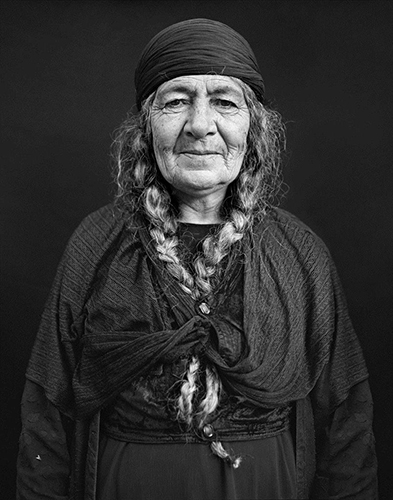
The passage of time in these circles chisels its own image on human faces as if the person has lived for centuries. This collection is images of followers of “Dinyari” religion in Iranian Kurdistan, more commonly known as “Yaresan”*.
I had the opportunity to visit the area purposely to observe the festivities that is called “Khavankar”*, during which the inhabitants of villages and cities of the area gather to meet their elder in a village called “Toot Shami”*. By mid day the audience gather, and to music of Tambour, they sing their collective prayers and visit the leader and the elders. Among the more than five hundred people that were present few faces were calling to me. I invited them to be photographed with a black backdrop that I prepared, and they calmly faced my camera for few minutes and stared at the lens.
These images are a cut from a “Doon”, with gazes that are as old as humanity.
Nima Alizadeh

*Yarsanism, The Yarsan or Ahl-e Haqq,”People of Truth”, is a syncretic religion founded by Sultan Sahak in the late 14th century in Western Iran and Iraq. For more info: http://en.wikipedia.org/wiki/Yarsanism.
*Khavankar is a three day festival in mid Autumn and followers gather to celebrate it mainly in the village of “Toot Shami” in Dalahoo area of province of Kermanshah in Iran.